
How to Make a Perfect Quenelle (Step-by-Step Guide)
A quenelle is an oval portion of ice cream, mousse or cream. For a smooth one-spoon rocher, draw a warm, dry spoon through the mixture and roll your wrist as you lift. For a classic three-sided quenelle, pass a scoop between two matching spoons, smoothing a different side with each pass.

Tools for this recipe
The equipment linked below uses the current Nordic Chefs product options, prices and availability.

Quenelle spoon Kit – Curvey Handle, Jet Black
Use the existing Nordic Chefs product page for current options, compatibility, price and availability.

Professional Plating Tool Kit – Curved Handle Spoon
Use the existing Nordic Chefs product page for current options, compatibility, price and availability.
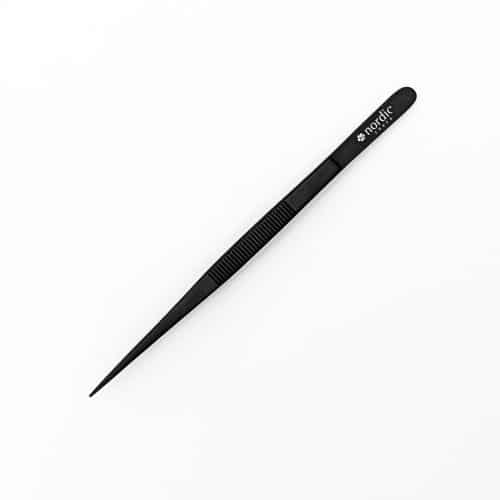
Nordic Chefs – Straight Chef’s Tweezers
Use the existing Nordic Chefs product page for current options, compatibility, price and availability.

Quenelle Spoon Curvey L – Jet Black
Use the existing Nordic Chefs product page for current options, compatibility, price and availability.
How to Make Ice Cream for Quenelles – Smooth Vanilla Base Recipe
Ingredients and method from the original Nordic Chefs recipe.
Print recipeIngredients
- 500 ml whole milk
- 150 ml cream
- 100 g sugar
- 2 tsp vanilla extract or 1 pod
- 4 egg yolks
Method
- Heat the milk and cream in a saucepan until just below boiling.
- Whisk the egg yolks and sugar until pale. Slowly pour the warm milk mixture into the yolks, whisking continuously.
- Return to the pan and stir gently until the custard reaches 82°C. Strain, add the vanilla, chill completely, then churn. Freeze until firm enough to hold a quenelle.
What Is a Quenelle?
In modern plating, a quenelle is a smooth, oval portion of ice cream, mousse, cream or purée. A classic quenelle is shaped between two spoons; a one-spoon rocher has a rounded, smooth finish. The word also refers to traditional French preparations made from fish or meat mixtures.
In modern gastronomy, the quenelle is not just a scoop — it is a technique that reflects precision, control, and presentation.
How to Make a Perfect Quenelle (Step-by-Step)
1. Choose the right spoon
A curved quenelle spoon helps control the shape and release of ice cream, mousse and other soft preparations. For the classic two-spoon method, use two spoons of the same size. For a one-spoon rocher, choose a shape and grip you can roll comfortably through the mixture. Compare spoon sizes, Curvey and Texture handles, and kits in our quenelle spoon collection. The listed 14 cm and 20 cm sizes refer to total spoon length, not the size of the finished portion.
2. Warm the spoon
Dip the spoon in warm water to prevent sticking and ensure a smooth glide.
3. Scoop in one motion
Drag the spoon through the product in one clean movement. Avoid stopping or reshaping too much.
4. Shape and release
Rotate slightly and place it gently onto the plate.
5. Clean and repeat
Always clean or reheat the spoon between each quenelle for consistency.
How to Quenelle Ice Cream (Professional Method)
Ice cream is one of the most common uses of this technique, but also one of the most difficult.
To achieve a perfect quenelle:
- The ice cream must be slightly tempered, not rock solid
- The spoon must be warm and clean
- The motion must be confident and continuous
If the ice cream is too cold, it will crack. If it is too soft, it will collapse.
One Spoon vs Two Spoons – What’s the Difference?
One-spoon rocher method
- smoother and more refined
- used in Michelin kitchens
- requires more practice
How to make a quenelle with two spoons
Use two spoons of the same size. Dip them in warm water and shake off the excess. Scoop a portion of mousse, cream or softened ice cream with one spoon, then use the second spoon to lift and turn it. Pass the portion between the spoons, smoothing a different side each time, until you have an oval with three defined sides. Gently release it onto the plate.
Watch Chef Mads shape and stack seven quenelles. Follow the turn of his wrist as he lifts each scoop.
Why Are Chefs Obsessed with the Quenelle?
It has become a signature technique in professional kitchens for several reasons:
- Visual precision – smooth, symmetrical shape with no sharp edges
- Consistency – repeatable portion size
- Texture showcase – highlights the smoothness of the product
- Plating flow – guides the eye across the plate
It is a minimalist technique that creates maximum visual impact.
Rocher vs Quenelle – What’s the Difference?
A classic quenelle is shaped between two spoons, creating an oval with three defined sides. A rocher is formed with one spoon in a continuous rolling motion, producing a rounded, smooth shape. Both techniques are used in professional kitchens for ice cream, mousse and other soft preparations. In everyday kitchen language, “quenelle” is also often used for the one-spoon shape.
Common Mistakes When Making a Quenelle
- Ice cream too cold → cracks and breaks
- Spoon not heated → sticks and tears
- Overworking the shape → uneven surface
- Incorrect angle → no symmetry
Mastery comes from consistency and repetition.
What Does “Quenelle” Mean?
The word “quenelle” comes from French cuisine and originally referred to a mixture shaped into an oval using two spoons. Today, it is used both as a dish and as a plating technique.
Tools That Make a Difference
While technique is key, the right tools can make the process significantly easier:
- Quenelle Spoon Curvey M – a professional curved spoon for controlled one-spoon shaping. For both Curvey sizes, choose the Curvey Handle Quenelle Spoon Kit, or compare the Texture Handle Quenelle Spoon Kit.
- Chef tweezers – precision tools for plating and garnish placement, including the Full Curved Utensils Kit with a quenelle spoon and spatula.
- Silicone molds – for structured desserts.
In professional kitchens, consistency often comes down to the tools used.
Check Out – Lobster Dessert Recipe by Chef Claus from Michelin Restaurant MOTA
Or perhaps you would try your hands on our popular croustade recipe?